
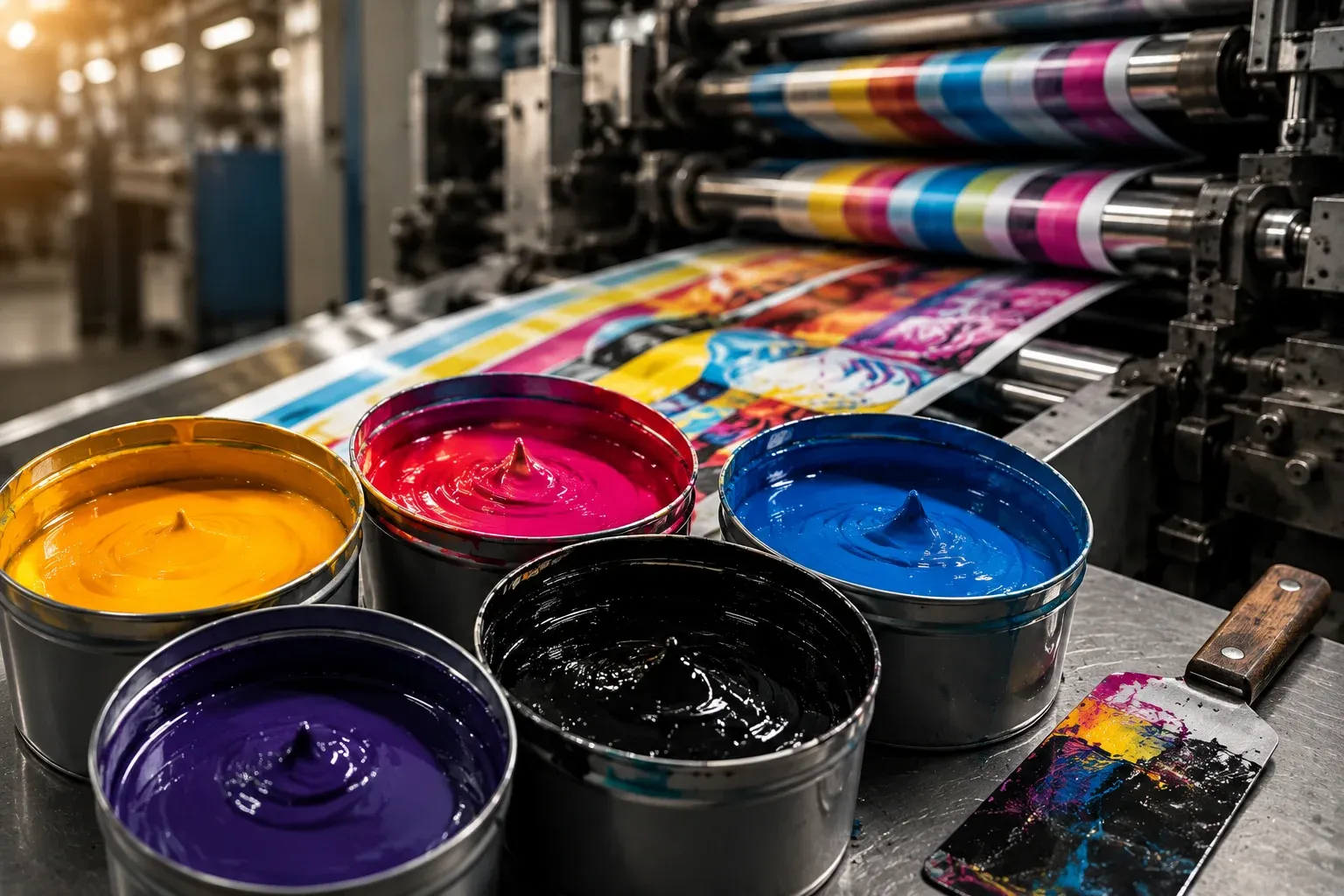
Flexographic printing has become an important printing method for packaging, labels, paper products, and various flexible materials. Its ability to deliver efficient and consistent printing at high speeds makes it suitable for a wide range of applications. However, achieving good print quality depends not only on the printing press but also on selecting an ink formulation that matches the substrate and production conditions.
What Are Flexographic Inks?
Flexographic inks are specially formulated for use with flexographic printing presses. During the printing process, ink moves from the ink chamber to the anilox roll, then to the flexible printing plate before being transferred onto the substrate.
Depending on the application, flexographic inks may be water-based, solvent-based, or UV-curable. Each type has different characteristics related to drying, adhesion, colour strength, and resistance. Therefore, the right ink needs to be selected according to the material being printed and the requirements of the finished product.
Applications of Flexographic Inks
Flexographic printing is commonly used for packaging and commercial printing applications. Its versatility allows it to work with materials such as paper, films, foils, and corrugated substrates.
Some common applications include:
- Flexible food and consumer packaging
- Paper bags and wrapping materials
- Labels and tags
- Corrugated packaging
- Plastic films
- Commercial and industrial packaging
Each application can have different requirements. For example, printing on plastic films may require strong adhesion and controlled drying, while paper substrates may require different ink absorption and flow characteristics.
Factors to Consider When Choosing an Ink Supplier
When selecting a flexo ink supplier in India, printers should consider several technical and quality-related factors rather than focusing only on cost.
1. Substrate Compatibility
Ink compatibility with the printing substrate is one of the most important considerations. Different films, papers, coated surfaces, and other materials have different surface properties. The selected ink should provide appropriate adhesion and coverage without causing common problems such as poor bonding or uneven printing.
2. Colour Consistency
Colour consistency is essential when producing packaging and labels, particularly when the same design is printed repeatedly. Consistent pigment dispersion and proper quality control can help maintain colour strength and appearance from one batch to another.
3. Drying Performance
Drying characteristics can have a direct effect on printing efficiency. An ink that dries too slowly may cause blocking, smudging, or other issues during rewinding and finishing. On the other hand, excessively fast drying can affect ink transfer on the press. The ink formulation should therefore match the press speed and drying system.
4. Viscosity and Ink Transfer
Stable viscosity helps maintain predictable ink transfer during flexographic printing. Since the anilox roll controls the amount of ink transferred to the plate, suitable viscosity and flow properties are important for achieving uniform coverage and clear print details.
5. Adhesion and Resistance
Depending on the end application, printed surfaces may need resistance to rubbing, moisture, chemicals, or other environmental factors. A suitable formulation should provide the required adhesion and performance for the intended application.
Importance of Technical Support
A reliable flexo ink supplier in India can provide more than just ink products. Technical understanding and application support can help printers select suitable formulations for specific substrates and press conditions.
Technical support can also be useful when printers change substrates, increase printing speeds, introduce new designs, or experience issues with drying, colour, or ink transfer. Clear communication between the printer and supplier can help identify suitable solutions based on actual production requirements.
Role of Quality Control
Quality control is an important part of flexographic ink manufacturing. Raw materials, colour strength, viscosity, drying characteristics, and batch consistency need to be monitored to maintain reliable performance.
Spectra Inks provides printing ink solutions for different industrial and packaging applications, with attention to factors such as printability, colour consistency, and substrate requirements. Understanding these factors can help printers select an ink formulation that is appropriate for their specific processes.
Making the Right Selection
Before choosing an ink supplier, printers should clearly evaluate their substrate, press speed, drying equipment, colour requirements, and final product specifications. Discussing these factors with the supplier can make it easier to identify an ink system suited to the application.
Spectra Inks emphasizes the importance of matching ink characteristics with printing conditions and substrate requirements to support consistent flexographic printing performance.
Conclusion
Selecting a flexo ink supplier in India involves evaluating several factors, including substrate compatibility, colour consistency, drying behaviour, viscosity, adhesion, resistance, and technical support. A properly matched ink formulation can contribute to stable ink transfer, consistent print quality, and efficient production.
By understanding their specific printing requirements and discussing them with an experienced supplier, printers can make more informed choices and achieve reliable results across different flexographic printing applications.